A prop firm marketing strategy is the system a proprietary trading firm uses to turn strangers into challenge buyers and challenge buyers into repeat customers. The winning version in 2026 is not an ads budget. It is a full-funnel machine: partners and content bring traders in, fast and honest onboarding converts them, and email plus community keeps them buying - with every dollar tracked back to challenge revenue.
This playbook is built from running marketing for live prop firms and brokers, not from theory. We manage the databases, the affiliate programs, the communities and the campaigns for trading brands every single day, and we see which channels actually produce challenge purchases and which ones just produce screenshots for a report. This is the strategy we would build if we were launching or scaling a prop firm right now.
What a Winning Prop Firm Marketing Strategy Looks Like
Strip away the noise and every prop firm that grows in a durable way runs the same core structure:
- Partner-led acquisition. Trading educators, YouTube and Telegram creators, and affiliate networks send warm traders. Their trust transfers to your firm, and the cost is performance-based.
- Owned-channel retention. Email, Discord and Telegram monetize the database you already paid to build. This is where most prop firm revenue actually hides.
- Organic search and AI-search visibility. Traders research firms before buying. If comparison content, reviews and answers about your firm exist and rank, you win those decisions for free.
- Compliance-safe paid media. Paid still works, but only with educational framing and platform-safe creative. It amplifies a working funnel, it never rescues a broken one.
- Attribution to challenge revenue. Every channel is judged on one metric: challenge purchases and repeat purchases it produced. Not clicks, not followers, not impressions.
Most firms have one or two of these pieces. The growth compounds when all five run together, because each channel feeds the next: a creator sends a trader, the trader joins your Discord, your email sequences bring them back for a second challenge, and your comparison content closes the traders who went off to research you.
The One Number That Should Shape Your Entire Strategy
The average prop firm trader attempts 2.3 challenges before passing, and across the industry roughly 40% of prop firm revenue comes from retry purchases. Not from new traders. From traders who already failed once and chose to try again.
Read that again, because it should change how you allocate every marketing dollar. If nearly half your revenue comes from people already in your database, then a strategy that spends 90% of its budget on cold acquisition and nothing on lifecycle is optimizing the smaller half of the business.
This is why the highest-ROI move for most prop firms is not a new ad campaign. It is switching on the revenue sitting in the list: failed-challenge recovery sequences, pass congratulations with an upsell to a bigger account, payout celebrations that trigger referrals, and win-back campaigns for traders who went quiet. We broke down the exact flows in our guide to prop firm email sequences and the full infrastructure in email marketing for prop firms.
A trader who just failed a challenge is not a lost customer. They are your highest-intent prospect. They already trust you with money, already know your rules, and already want to pass. The only question is whether their retry happens with you or with a competitor whose remarketing reached them first.
The Prop Firm Channel Stack, Ranked by What Converts
Here is every meaningful prop firm marketing channel, ranked by revenue impact per dollar as we see it across the trading brands we run.
1. Email and lifecycle - the revenue engine
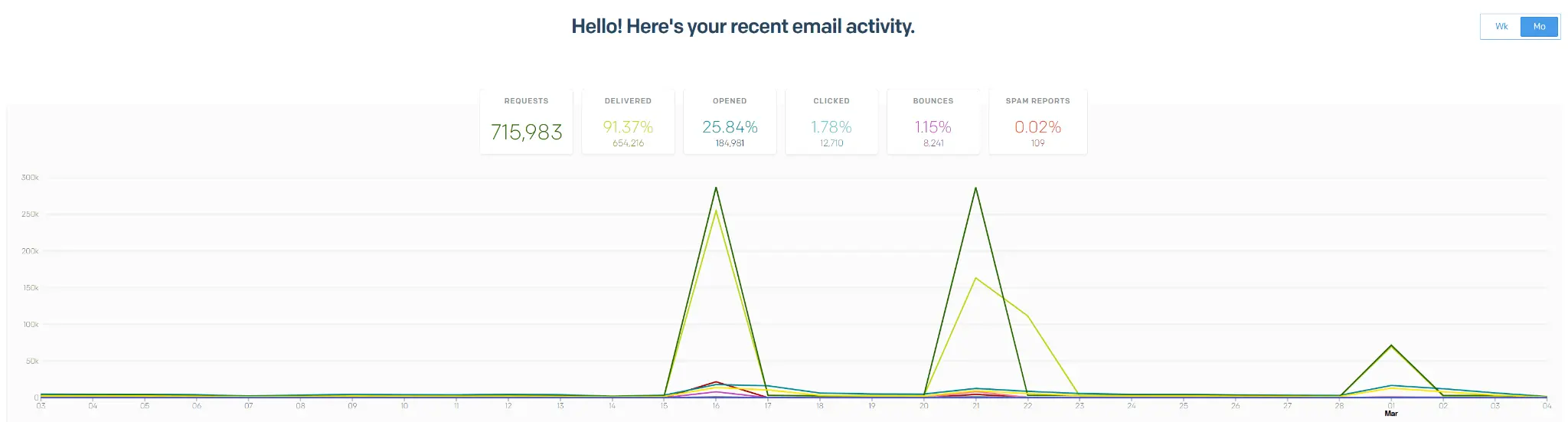
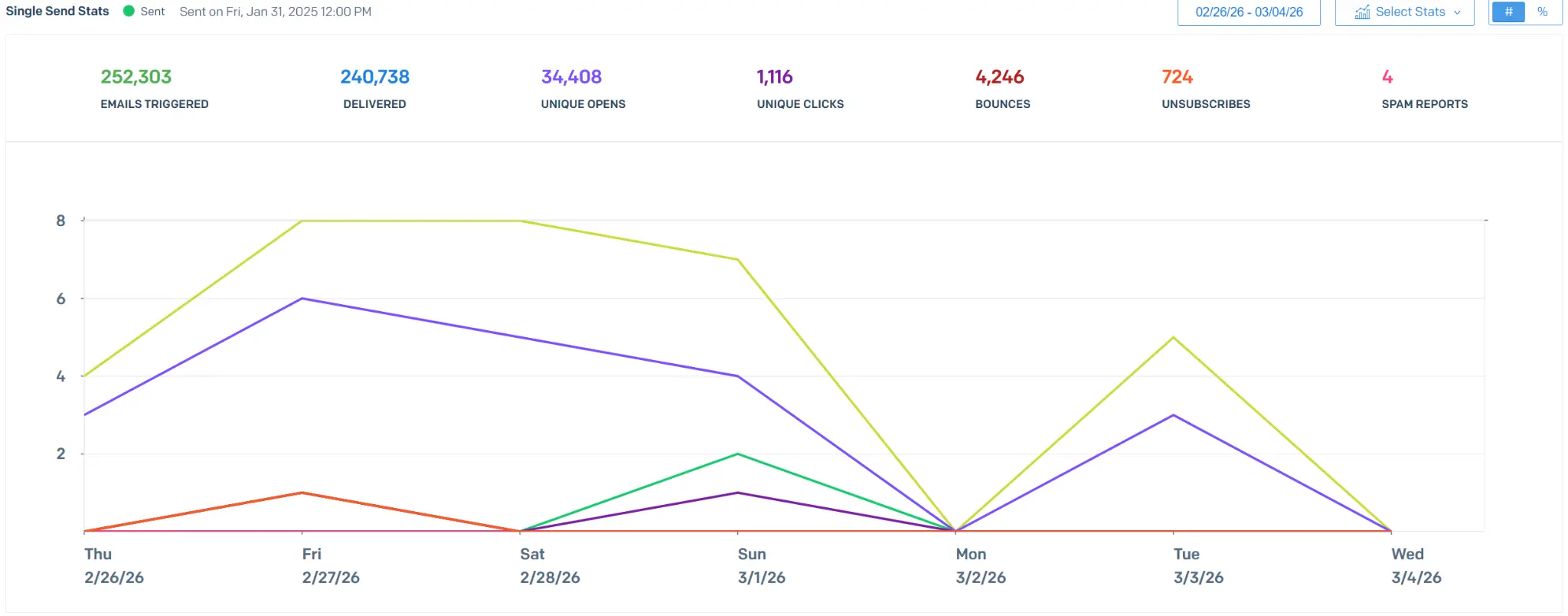
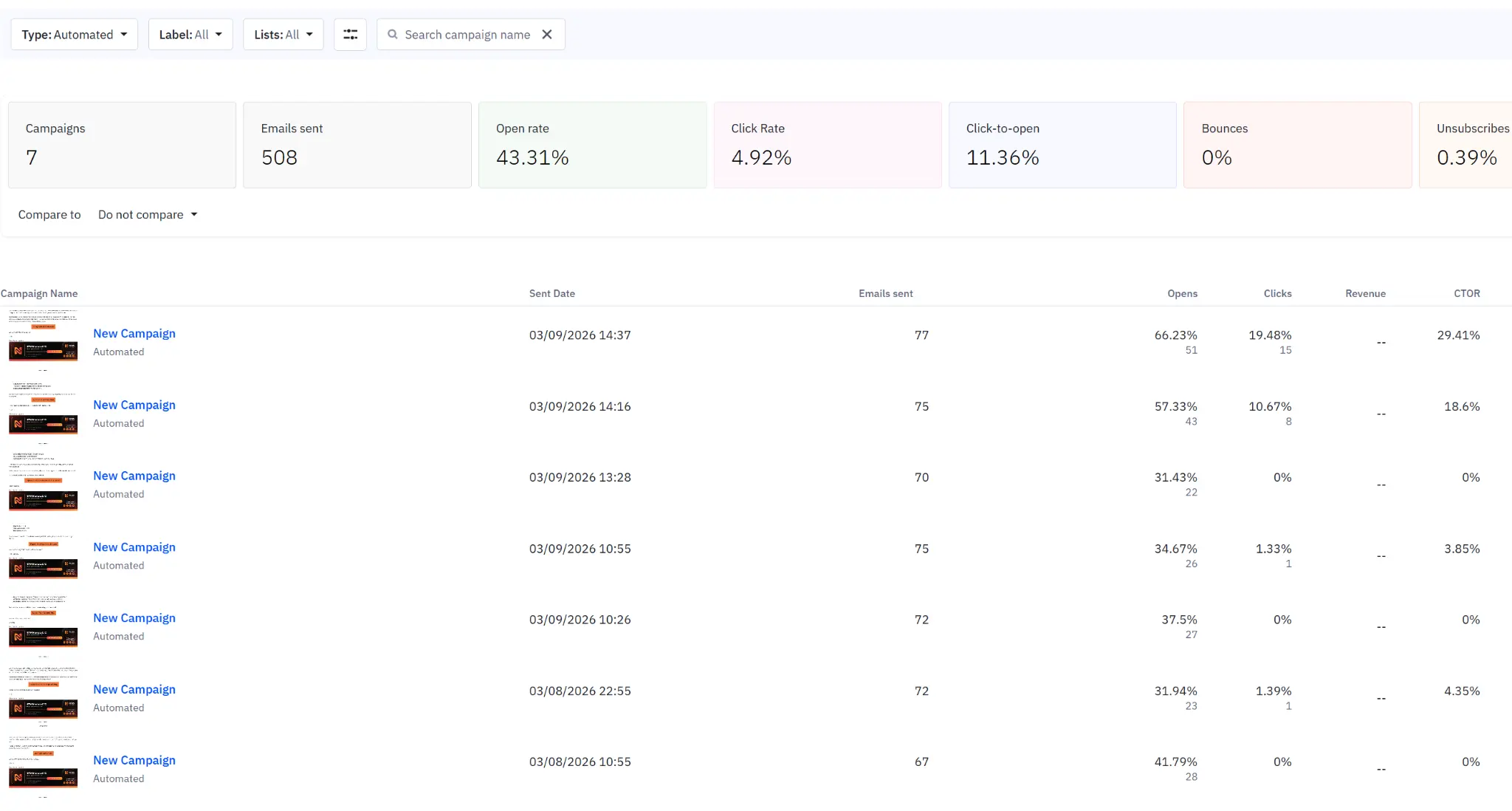
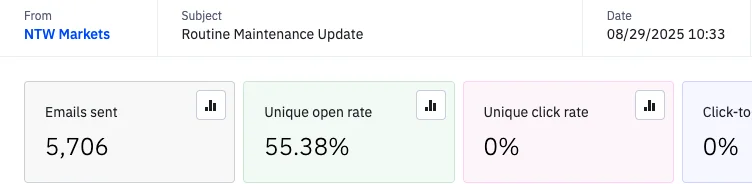
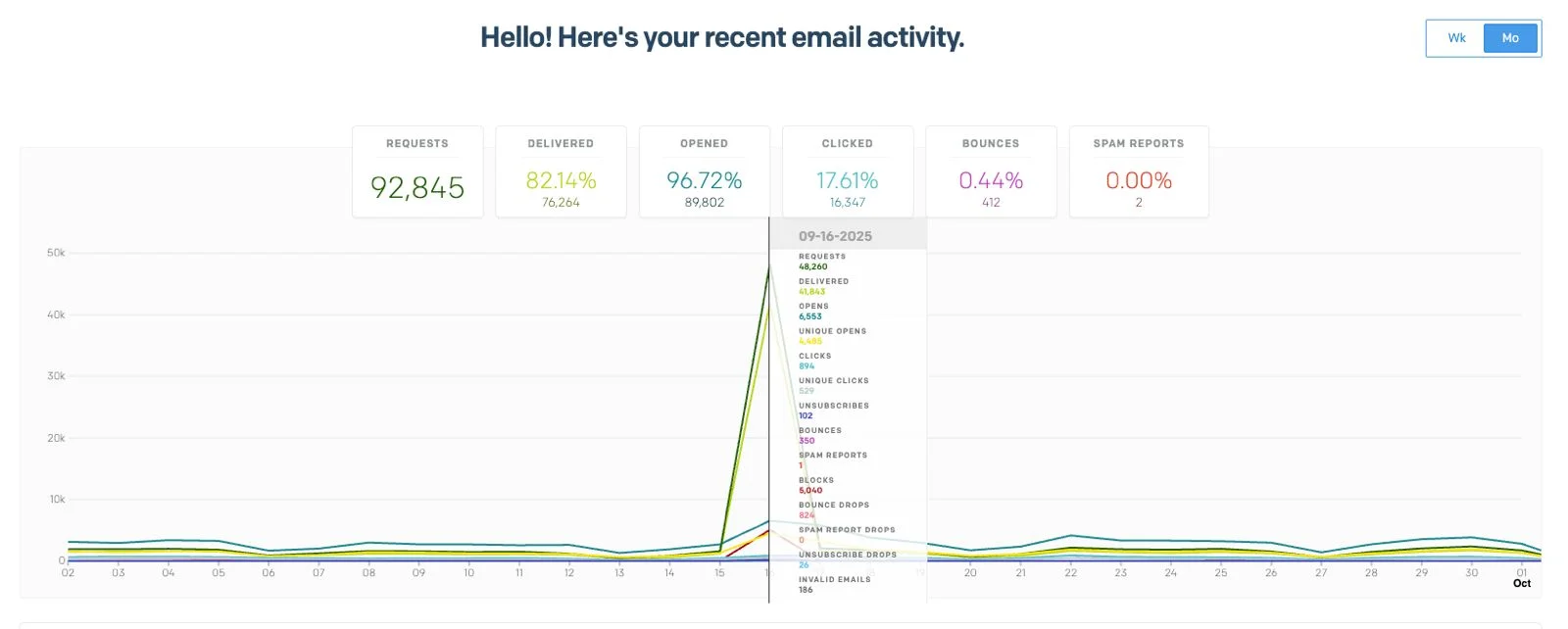
Email is first because it converts the audience you already own. Across trading brands we manage, rebuilt email programs average 25%+ open rates on lists of 300,000+ contacts, with top campaigns reaching 45%+ opens while the industry average sits near 20%. Automated journeys run at 43% opens and 5-6% click-through against an industry norm of 2-3%. One brokerage turned a dormant 300K list into $450K+ in attributed revenue with this exact approach.
For a prop firm the same mechanics map onto the challenge lifecycle: welcome and first-purchase sequences, mid-challenge encouragement, fail-recovery with a retry incentive, pass-upsell to larger accounts, payout moments, and dormancy win-backs. If you run one channel yourself, run this one.

2. Affiliates, educators and IB-style partners - the acquisition engine
The three highest-converting partner profiles for prop firms are trading educators on YouTube, signal and community operators on Telegram, and Discord community moderators. Their audiences already trust them, and that trust transfers to your challenge page. One partner program we run recruited 100+ active affiliates and produced $300K+ in deposits within 90 days; a single program generated $161K net over 180 days.
The difference between a partner program that grows and one that stalls is management: tracked links and clean dashboards, tiered commissions that reward volume, monthly bonus ladders, leaderboards, and ready-made creative so partners never have to design anything. We covered the full operating system in affiliate and IB program management, and the strategic comparison in introducing broker vs affiliate.
3. Community - the trust engine
Discord and Telegram are where prop traders actually live. A well-run community shortens the distance between "heard of you" and "bought a challenge" because prospects watch real traders pass, get payouts and talk about it. Communities are also your pressure valve for paid-platform restrictions: promotions that ad platforms will never approve can live in your own channels, sent to people who opted in.
Daily cadence wins: market opens, challenge promos, payout celebrations, meme moments, educator AMAs. Silence kills communities faster than any competitor can.
4. SEO and AI-search visibility - the decision engine
Before buying a challenge, traders search: "best prop firm", "your-brand review", "your-brand vs competitor". In 2026 those questions are answered as much by ChatGPT, Perplexity and AI Overviews as by classic Google results. The firms that win are the ones whose sites answer questions directly and whose names appear across comparison content, reviews and industry press - because that is the material AI assistants cite.
This compounds. For one trading client, organic clicks to the homepage grew +9,662% after a structured SEO rebuild, and the site now converts research traffic we never pay for. The same playbook - answer-first pages, FAQ schema, comparison content, entity consistency - is what gets a firm cited by AI assistants when traders ask which prop firm to choose.
5. Paid media - the amplifier
Paid ads for prop firms work under two conditions: the funnel behind them already converts, and the creative survives platform review. Meta has become extremely strict with trading offers - direct "get funded, withdraw profits" messaging gets accounts flagged. What passes review is educational and platform-focused framing: showcase the tools, the rules transparency, the trader stories. We compared the economics in email marketing vs paid ads for trading companies: cold paid acquisition costs multiples of what lifecycle revenue costs, so paid earns its place only after owned channels are switched on.
6. Social content - the credibility layer
Organic social rarely converts directly for prop firms, but it decides whether the traffic from every other channel trusts you. Payout proof, trader interviews, platform updates and educational shorts give researching traders a live, active brand to find. Our guide to social media marketing for trading brands covers formats and cadence, including what is safe to post on Meta properties in this niche.
How to Split a Prop Firm Marketing Budget
Exact numbers depend on stage, but the allocation logic holds across every prop firm we have worked with:
- 35-40% to lifecycle and retention - email infrastructure, sequences, community management. Highest ROI because it monetizes existing traffic, and it is the cheapest of all channels to operate.
- 25-30% to partners - affiliate commissions, educator deals, program management and partner creative. Performance-based, so spend scales with revenue.
- 15-20% to content, SEO and AI-search - comparison pages, review presence, question-answering content. Slowest to start, compounds the longest.
- 10-20% to paid media - only once the funnel converts, with compliant creative and hard attribution.
The common failure mode is the inverted pyramid: most of the budget on paid ads at the top, nothing on the lifecycle that turns a $500 challenge buyer into $1,150+ of lifetime purchases. Fix the allocation before you scale the spend.
Want the exact strategy mapped to your firm?
Compliance-Safe Messaging on Meta and Google
Ad platforms treat trading offers as high-risk, and enforcement got materially stricter through 2025 and 2026. We manage Meta presence for multiple trading brands and the pattern is consistent: direct money-mechanics messaging - deposit bonuses, "get funded fast", profit promises - gets posts removed and accounts restricted, even on organic content.
What survives review and still converts:
- Educational framing. "Test your strategy against real market conditions" passes. "Turn $500 into a $200K funded account" does not.
- Platform and transparency content. Showcase the dashboard, the rules, the payout process. Feature-level content is safe and builds exactly the trust prop traders need.
- Brand and community content. Trader stories, educator collaborations, event coverage. Human content that never trips financial-services filters.
- Owned channels for the hard sell. The aggressive promos live in email, Telegram and Discord, where the audience opted in and no platform reviewer stands between you and your list.
The strategic consequence: your owned database is not just a retention asset, it is the only place you can market at full strength. Every restriction on paid platforms raises the value of every contact you own.
Measuring What Matters: From Clicks to Challenge Revenue
Most prop firm marketing reports are theater: impressions, reach, follower growth. None of it tells you whether marketing made money. The measurement standard we hold ourselves to is attribution to revenue - challenge purchases, retries and upgrades traced back to the campaign, partner or sequence that produced them. Across trading clients we have attributed $4.8M in trader deposits to marketing activity in a single three-month window, down to the channel.
The metrics that belong on a prop firm dashboard:
- Revenue per channel - challenge purchases attributed to email, partners, organic and paid, weekly.
- Retry rate and time-to-retry - what share of failed traders buy again within 30 days, and whether your recovery sequences move it.
- Cost per funded account, not cost per lead - a thousand cheap leads that never buy cost more than a hundred referrals that do.
- List health - engaged share of the database, opens and clicks by segment. We consider 30% of a 300K list actively engaging a healthy benchmark, not a ceiling.
- Partner concentration - what share of deposits your top three partners control, because that is your risk profile.
If a channel cannot be traced to revenue after 90 days, it gets fixed or cut. That discipline alone would improve half the marketing budgets in this industry.
The 90-Day Prop Firm Marketing Plan
Days 1-15: audit and switch on owned revenue
Audit the database, deliverability and funnel. Segment the list: active traders, failed-not-retried, dormant signups, past payouts. Ship the first recovery and reactivation campaigns - this typically produces the first attributable revenue inside two weeks, because the audience already exists.
Days 16-45: build the lifecycle machine and open the partner engine
Deploy the full sequence set: welcome, mid-challenge, fail-recovery, pass-upsell, payout, win-back. In parallel, launch the partner program: tracking, tiers, creative kit, and direct recruitment of educators and community operators in your niche. First partner deposits usually land in weeks 4-8.
Days 46-90: content, community and paid amplification
Stand up the comparison and answer content that captures researching traders, tighten the community cadence, and - only once the funnel demonstrably converts - test compliant paid campaigns into the strongest segments. End the quarter with attribution reporting per channel and reallocate based on revenue, not opinion.
Seven Mistakes That Kill Prop Firm Growth
- Spending everything on acquisition while 40% of potential revenue - the retry economy - goes unmanaged.
- Blasting one generic email to the whole list. A failed trader and a funded trader need opposite messages. Segmentation is the whole game.
- Running partners without management. Recruiting affiliates is easy; keeping them active requires dashboards, bonus ladders and fresh creative every month.
- Posting money-mechanics content on Meta and losing the account that took years to build. Save the hard sell for owned channels.
- Ignoring AI search. Traders now ask ChatGPT which prop firm to pick. If your brand has no cited presence, you lose deals you never knew existed.
- Measuring vanity metrics. Impressions do not buy challenges. Attribution to revenue or it did not happen.
- Hiring generalists. Agencies that learned marketing on ecommerce budgets do not know what a breach email should say or why a payout post converts. Our guide on choosing a marketing agency for a trading business covers what to demand.
How We Run Prop Firm Marketing at AIM
AIM is the growth marketing partner for brokers and prop firms - built exclusively for the trading industry, where every client is a prop firm, broker, CFD brand or trading educator. We do not sell packages. Every engagement starts with an audit of your funnel, database, partners and content, and the solution is assembled from what the audit finds.
What makes our model different is the marketing command center: every campaign, deliverable and dollar of attributed revenue lives on one platform you log into. You see what shipped this week, what it produced, and what is next - no black box, no monthly PDF. The proof: 25%+ average opens across 300K+ contact lists, 100+ affiliate partners recruited with $300K+ in 90-day deposits, and $4.8M in attributed deposits across a single quarter. If you want the full picture of who does what in this niche, we published an honest comparison of the best marketing agencies for forex brokers and prop firms, including where we are not the right fit.
Get a free audit of your prop firm's marketing - see exactly where the revenue is leaking.
Frequently Asked Questions
What is the best marketing strategy for a prop firm?
The best prop firm marketing strategy combines partner-led acquisition (trading educators, YouTube and Telegram creators, affiliates), owned-channel retention (email sequences, Discord and Telegram communities), and organic search plus AI-search visibility - with every channel measured by attributed challenge revenue. Retention deserves the largest share of budget because roughly 40% of prop firm revenue comes from retry purchases by traders already in the database.
How much should a prop firm spend on marketing?
Allocation matters more than the absolute number. A healthy split is 35-40% to email and lifecycle, 25-30% to affiliate and educator partnerships, 15-20% to content and SEO, and 10-20% to paid media once the funnel converts. Growth-stage firms commonly invest a significant share of revenue into marketing, but the fastest ROI comes from monetizing the existing database before scaling cold acquisition.
What is the highest-converting marketing channel for prop firms?
Email and lifecycle marketing convert highest per dollar because they target traders who already bought or signed up. Well-run trading-brand email programs average 25%+ open rates on 300K+ lists with automated journeys at 43% opens and 5-6% click-through, versus the 2-3% industry norm. For new-trader acquisition, educator and community partnerships convert best because the partner's trust transfers to the firm.
How do prop firms get more traders?
The reliable sources are partnerships with trading educators and community operators, comparison and review content that captures traders researching firms (including AI assistants like ChatGPT), an active Discord or Telegram community that shows real passes and payouts, and recovery campaigns that bring failed-challenge traders back for retries. Paid ads work as an amplifier once those foundations convert.
Can prop firms run ads on Meta and Google?
Yes, but only with compliant framing. Platforms treat trading as high-risk: direct money-mechanics messaging - funded-account promises, deposit bonuses, profit claims - gets rejected and can restrict the ad account. Educational and platform-focused creative passes review. The aggressive promotions belong in owned channels like email, Telegram and Discord where the audience opted in.
How long does prop firm marketing take to produce results?
Email and lifecycle campaigns typically produce measurable revenue within the first 30 days because they monetize contacts the firm already owns. Affiliate and educator programs take 60-90 days to build active deposit flow. SEO and AI-search visibility compound over 6+ months. A well-sequenced plan switches on owned revenue first so later channels are funded by results, not hope.
Should a prop firm hire a marketing agency or build in-house?
Below roughly $750K in annual marketing spend, a specialist trading-industry partner usually beats hiring, because one retainer buys email, affiliate, content and community execution that would take four hires to cover. The non-negotiable is niche specialization: an agency that has never written a breach email or run a challenge promo will learn on your budget. Demand verifiable trading-industry results and revenue attribution.