Most brokers find out their email deliverability is broken at the worst possible moment - right after they hit send on the biggest campaign of the quarter. A multi-jurisdiction forex broker came to us in exactly that situation. They had a large trader book, real reason to email it, and every previous big send had quietly fallen apart. The mail went out, the deposits did not come back, and the conclusion they had reached was that email "does not work" at their volume.
It worked fine. The infrastructure underneath it did not. This is the breakdown of one campaign we ran on the rebuilt system: 252,303 emails triggered, 240,738 delivered, 34,408 opens - over 95% inbox placement at a quarter-million-email volume - and the exact deliverability sequence that made it hold.
The Problem: A Quarter-Million Emails Into Spam
When you sit on a six-figure contact list, the math on a single campaign is enormous. A promotion to 250,000 traders that lands in the inbox is a real revenue event. The same promotion that lands in spam is worse than sending nothing, because the failed send actively damages the domain you will need for the next one.
That is the trap this broker was in. Their pattern looked like this: take the full list, push it through a shared sending pool, fire the whole thing at once, and watch the open rate decay over a few hours as inbox providers throttled the domain mid-send. By the time the campaign finished, a large slice of it had never reached a human. Three things were stacked against them:
- Shared IP, borrowed reputation. They were sending from a pooled IP, which means their inbox placement was hostage to whatever every other sender on that IP was doing. One bad neighbor blasting spam tanks your delivery, and you never see it coming.
- Broken authentication. SPF, DKIM, and DMARC were either missing or misconfigured. Financial mail already gets extra scrutiny from every major inbox provider, so a finance domain that cannot prove who it is gets filtered on sight, no matter how clean the copy is.
- No sending order. The entire list went out in one undifferentiated blast - fresh signups and traders who had not opened anything in a year, all in the same wave. That spike of mail to disengaged people is the single loudest spam signal a domain can send.
At this volume, deliverability is not a detail. It is the whole campaign. A 5% swing in delivery on a quarter-million send is ~12,500 traders who either hear from you or never do.
Why Big Broker Sends Collapse
The broker was not doing anything exotic. They were doing what most brokers do with a big list, and that is precisely why it failed. The default instinct is to treat the CRM like a megaphone: bigger list, bigger blast, bigger result. Inbox providers read that exact behavior as the signature of a spammer.
Here is the mechanism. Gmail, Outlook, and the rest do not score your individual emails as much as they score your domain's reputation over time. When 250,000 messages suddenly leave a domain that normally sends a trickle, and a large share of those recipients do not open, the providers infer the mail is unwanted. They start routing it to spam and promotions, then throttle the domain so later batches in the same send get delivered slower or not at all. Financial content sits in a higher-scrutiny category to begin with, so brokers hit this wall faster and harder than a typical retailer would.
The fix is not better copy. It is sending order and reputation. You warm the domain on the people most likely to open, you authenticate every message so providers trust the source, and you gate your coldest segments behind engagement recency so they never drag the domain down at the exact moment you need it most. That is an infrastructure job, and it is where we started.
Our Process: Deliverability as Infrastructure
We do not blast lists. We build the infrastructure that lets a list of this size actually reach the inbox, then we send into it. Before a single revenue email went out, the deliverability layer got rebuilt from the ground up. This is the same sequence we run across our broker email engagements.
Step 1: Verify and clean the list
We ran the full contact list through verification to strip invalid addresses, hard bounces, role-based inboxes like info@ and admin@, and known spam traps. Spam traps are the most dangerous of these - hitting even a handful tells inbox providers you are not managing list quality, and they will punish the whole domain for it. A dirty list at quarter-million scale does not just underperform, it poisons every send after it. A smaller clean list beats a bigger dirty one every time.
Step 2: Fix authentication and stand up a dedicated IP
We configured the three protocols that prove a message is legitimately from the broker's domain:
- SPF - declares which servers are allowed to send for the domain
- DKIM - cryptographically signs every email so it cannot be altered in transit
- DMARC - tells providers what to do with mail that fails the first two checks
Then we moved the broker off the shared pool and onto a dedicated sending IP, so their sender reputation belonged to them alone and could not be sunk by a stranger's bad sending. For the deep version of this layer, see our email deliverability playbook for trading brokers.
Step 3: Warm the domain on engaged traders first
You cannot fire a quarter-million emails off a fresh dedicated IP and expect the inbox. We ran a structured warmup: early sends went only to the most recently engaged traders, the people most certain to open, then volume scaled gradually while we monitored bounces, complaints, and inbox placement at every step. High open rates on those early sends are the signal that builds domain reputation, and that reputation is what buys inbox placement for the big volume later.
Step 4: Gate cold segments behind engagement recency
This is the step that protects the campaign. We segmented the list by engagement recency, not just by demographics. Thirty-day openers get every send. Colder segments only get the strongest, most relevant campaigns, and the long-dormant tail gets reintroduced carefully rather than blasted on day one. That sequencing is what stops a disengaged cohort from dragging the domain into spam right when the big send goes out.
Step 5: Send big, with finance-safe formatting
Only with the infrastructure right did the quarter-million-email campaign go out. The copy followed the rules that keep finance mail deliverable: tight subject lines, no spam-trigger language, a clean text-to-image ratio, and a single clear action. The same message that would have been filtered on the old setup now had a warmed domain, a clean list, and full authentication carrying it into the inbox.
Sitting on a six-figure list that keeps landing in spam?
The Results: 240,738 Delivered at 95%+
The campaign that used to collapse into spam now reached the inbox at scale. This is one single-send campaign on the rebuilt infrastructure:
The Numbers
- 252,303 emails triggered in a single campaign to the trader book
- 240,738 delivered - over 95% inbox placement at quarter-million volume
- 34,408 opens generated off that one send
- Same list, same broker - the only thing that changed was the infrastructure underneath the send
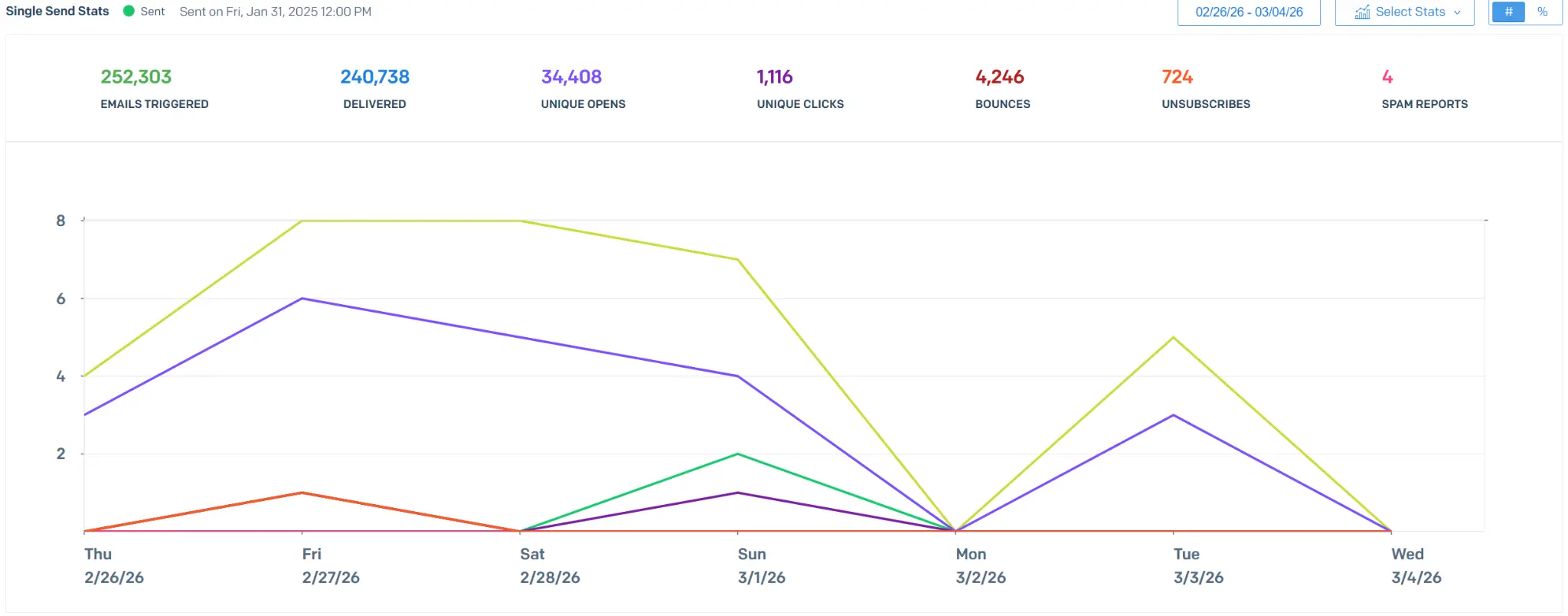
Platform view of the single campaign: 252,303 triggered, 240,738 delivered, 34,408 opens.
For context, the 95%+ delivery on this campaign is not a one-off spike. Across this broker's recent traffic, a 30-day window covered 715,983 sends at a 91.37% delivery rate, and a tighter 7-day window hit 94.03% delivered on 85,243 sends. The infrastructure holds at volume because it was built to.
The Moat: A List Versus an Asset
The number that matters here is not 240,738. It is the 95%+ delivery, because that is the asset that keeps producing. A campaign is a one-time event. The infrastructure behind it - clean verified list, dedicated IP, authenticated domain, restored reputation, engagement-gated sends - is permanent. Every future broadcast now sends into a system that reaches the inbox instead of fighting the spam filter.
This is the difference between owning a list and owning an asset. A list is a row count in a CRM. An asset is a channel you can return to every month, with a sender reputation that compounds upward instead of decaying with every clumsy blast. At a quarter-million-email volume, deliverability is not a feature of the channel. It is the channel.
We did not write this broker better emails. We rebuilt the road those emails travel on, so they actually arrive.
What This Means for Your Brokerage
If your big sends decay into spam within hours and you have decided email "does not scale" for your audience, you are not looking at a marketing problem. You are looking at infrastructure that was never built for the volume you are pushing through it. The traders are already in your CRM. The only question is whether your domain is trusted enough to reach them.
The sequence above is repeatable: verify and clean, authenticate, move to a dedicated IP, warm the domain on engaged traders, gate the cold segments, then send big. That deliverability layer is the mechanism behind The Retention Engine - the productized 90-day engagement we run for brokers, backed by a written guarantee of $500,000 in gross attributed trader deposits or a full refund. Delivery rates like the 95%+ in this case study are not the promise. They are what makes the deposit number reachable. We run it for brokerages with a minimum of 5,000 contacts in their CRM, integrated with ActiveCampaign, HubSpot, SendGrid, or a proprietary back office.
Ready to make your next quarter-million-email send actually reach the inbox?
Frequently Asked Questions
Can a broker really send 250,000 emails in one campaign without landing in spam?
Yes, but only on the right infrastructure. On this campaign the broker triggered 252,303 emails and delivered 240,738, which is over 95% inbox placement. That is not achievable from a cold shared IP with broken authentication. It requires a clean verified list, SPF, DKIM, and DMARC all passing, a dedicated sending IP carrying its own reputation, and a warmed domain. Skip any of those and a send this size gets throttled within hours. Get them right and the inbox holds at quarter-million volume.
Why do large broker email sends collapse into spam?
The default mistake is blasting the entire list at once from a shared IP. Inbox providers see a huge spike of mail going to people who do not open it, flag a chunk as spam, and quietly throttle the domain mid-send. Financial content already gets extra scrutiny, so brokers hit this wall faster than most. The fix is sending order and reputation: warm the domain on engaged traders first, gate cold segments behind engagement recency, and authenticate every message so providers trust the domain before the big volume goes out.
What is a dedicated sending IP and why does it matter for brokers?
A dedicated sending IP is an address used only by your brokerage, so your sender reputation is yours alone and not shared with strangers whose bad sending can tank your delivery. For a high-volume broker send, a clean dedicated IP is what lets you scale to a quarter-million emails while keeping bounces and complaints low. We stand one up, warm it, and monitor inbox placement at every step of the campaign so delivery holds at scale.
Does AIM guarantee deliverability results?
We guarantee the outcome that deliverability drives. Our 90-day Retention Engine engagement is backed by a written guarantee of $500,000 in gross attributed trader deposits or a full refund. Delivery rates like the 95%+ in this case study are the mechanism, not the promise - they are what make the deposit number reachable. We need a minimum of 5,000 contacts in your CRM to run it, and we integrate with ActiveCampaign, HubSpot, SendGrid, or your back office.