To reactivate dormant trading accounts, you first have to notice when they go dormant. A trader deposits $2,000, trades hard for a few weeks, then goes quiet. No login. No trade. No deposit. Most brokers do not even notice until months later, when a quarterly report flags the account as inactive. By then the trader is cold, has probably moved funds to a competitor, and winning them back costs more than the original acquisition did. That is the exact problem this brokerage came to us with, and it is the problem we built always-on reactivation journeys to solve.
This is a multi-jurisdiction forex broker sitting on thousands of funded-then-dormant accounts. Every one of those traders had already passed KYC and proven they will fund. The revenue was already in the building. The brokerage just had no system watching for the moment a trader stopped showing up, and no way to put the right message in front of that trader the same day it happened. We fixed that with seven automated journeys that now run around the clock, and this is the full breakdown of how.
The Problem: The Account Nobody Noticed Going Quiet
Reactivation is the cheapest revenue a brokerage will ever earn, and almost nobody works it. The trader who deposited $2,000 four months ago and went dark is worth more than a cold lead from an ad, because there is no acquisition cost left to pay. They are already verified. They have already trusted you with money once. The only thing standing between that account and another deposit is whether anyone reaches them with the right reason to come back, at the moment it matters.
This brokerage had three gaps compounding each other:
- No trigger on dormancy. Nothing in their stack watched login recency or last-trade date. A trader could go silent for 90 days and the system stayed silent right back. The window where a win-back actually works - the first weeks after a trader goes quiet - was closing every single day, unworked.
- One generic message for everyone. When they did try to re-engage, a $200 first-timer and a $10,000 VIP who lapsed got the identical email. Neither one converted, because neither one was written for them.
- It depended on a person remembering. Reactivation only happened when someone on the team had time to build and send a blast. That is the wrong place for revenue to live - in a task list that gets bumped every busy week.
A dormant trader is not a lost trader. They are a deposit you have not asked for yet, and the asking has a deadline.
Why Reactivation Campaigns Keep Failing
Most brokers do attempt reactivation. The problem is they do it as a campaign, and a campaign is the wrong tool for the job. A campaign is something a person has to remember to build, then send to whoever happens to be dormant on that specific day. It goes out on a Tuesday, it catches the traders who happened to go cold recently, and it completely misses the trader who went quiet the following Thursday. That trader sits unworked until the next time someone gets around to a blast, by which point the win-back window has already closed.
There is a second failure built into the campaign model. Because it fires for everyone at once, it cannot speak to the individual trader's situation. The message that re-engages a four-month-dormant scalper is not the message that re-engages a recent VIP who paused after a drawdown. Blast one email to both and you get the open rate you would expect from mail nobody asked for. The fix is not better copy on the blast. The fix is to stop blasting and start triggering off behavior, the same shift we walk through in our prop firm email sequences guide.
The Approach: Always-On Journeys Inside The Retention Engine
We do not send reactivation campaigns. We build reactivation infrastructure. Inside The Retention Engine, the work is a set of automated journeys that run 24/7 and trigger off each individual trader's behavior. The day a trader's login recency or last-trade date crosses into dormant, a sequence fires for that trader specifically, branched by their segment. No one presses send. The system is the one watching.
Step 1: Define what "dormant" means per segment
Dormant is not one thing. For an active day-trader, two weeks of silence is a real signal. For a swing trader who logs in once a week, it is noise. We set the dormancy triggers per segment using login recency, last trade, and deposit lifecycle, so each journey fires at the point that actually means something for that type of trader instead of an arbitrary 90-day cutoff that catches everyone too late.
Step 2: Branch the journey by who the trader is
A single journey is not one path. It branches on deposit size, lifecycle stage, channel, and trade outcomes, so the message a trader receives is built for their exact situation. The $2,000 depositor who went quiet after a losing streak hears a different sequence than the never-deposited signup who never got started. The dormant-but-funded trader is the highest-value branch in the whole system, because they have already passed KYC and proven they will fund, so reactivating them costs nothing in acquisition.
Step 3: Run it across the channels traders actually read
The journeys fire across email, SMS, and iMessage, individualized by which channel each trader engages with. A reactivation that never gets seen is not a reactivation, so the engine routes each trader's sequence to where they are most likely to open it.
Step 4: Make it permanent, not a one-time push
Once live, a journey does not stop. It is standing infrastructure. Every trader who crosses into dormant from this day forward gets worked automatically, with no one in the loop. The brokerage went from reactivation being a task someone had to remember to reactivation being a machine that never forgets.
Want a system that reactivates dormant traders without anyone pressing send?
The Results: 7 Journeys Running 24/7
The output is not a one-time spike. It is a set of standing machines, each one a reactivation sequence that fires on its own the moment a trader goes quiet.
The Numbers
- 7 live automated journeys running around the clock, each triggered by trader behavior
- 43.31% average open rate across those journeys, against an industry average of 12 to 15%
- 4.92% average click rate, traders actually moving to act, not just opening
- Zero manual sends - every sequence fires the moment a trader crosses into dormant, with no one in the loop
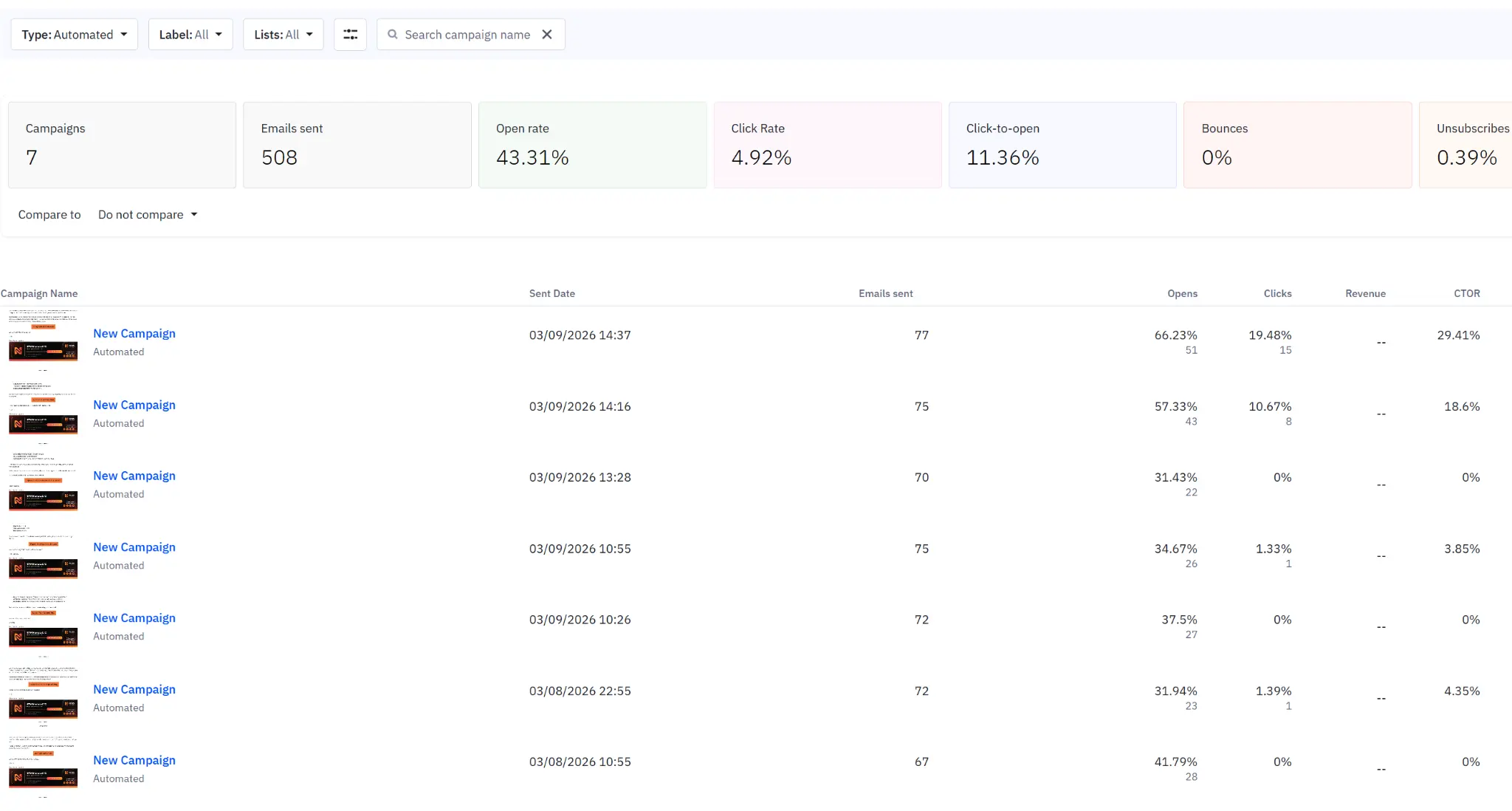
The journeys dashboard: 7 always-on reactivation automations holding a 43.31% average open rate and 4.92% average click rate, each one firing the moment a trader goes dormant.
The number that matters most is not the 43.31%. It is the word live. These seven journeys are not campaigns that ran once and ended. They are standing reactivation machines. A trader who goes quiet next Tuesday at 3am gets worked at 3am, automatically, with a sequence written for their segment. That is the difference between a result you have to re-earn every month and a result the system holds for you.
The Math On Recovered Deposits
The reason reactivation beats acquisition comes down to one fact: these traders already passed KYC and funded once, so there is no new ad spend behind the deposit. Every dollar a journey recovers is pure recovered revenue, not bought revenue. On our deployments, a minimum of 20% of inactive accounts get reactivated, and 30% or more traders deposit in the first week after the journeys go live. Those are floors, not ceilings.
Run that against a real book. A brokerage with several thousand dormant funded accounts, each one already worth a $2,000-plus deposit at some point, is sitting on a recovery line that needs no media budget to unlock. The journeys do the unlocking on autopilot. The exact recovery depends on list size and how long accounts have been dormant, which we map during setup, but the mechanism is the same in every case: stop paying to find new traders you already have.
And we prove the recovery is real, not estimated. We hold back a 5% dormant control group that receives nothing, then measure the deposit gap between the worked 95% and that control. The difference is the number we attribute to the work. Every message is UTM-tagged with a 7-day attribution window connected to your CRM. That same attribution is what our guarantee is written against: $500,000 in gross attributed trader deposits in 90 days, or a full refund, for any brokerage with at least 5,000 contacts. Across our deployments this approach has driven $4.8M in attributed trader deposits over the last three months.
We did not find this broker new traders. We built the system that wakes up the funded traders they already had, the moment those traders go quiet.
What This Means For Your Brokerage
If your book has thousands of funded accounts that have gone dark, you do not have an acquisition problem. You have a reactivation problem, and reactivation is the cheapest revenue you will ever earn because there is no ad spend behind it. The only question is whether anything in your stack notices the day a trader goes quiet and reaches them with the right message before the window closes.
Always-on journeys do exactly that. Seven of them, running 24/7 at 43.31% average open and 4.92% click, are standing reactivation infrastructure rather than a campaign someone has to remember. This is the core of how we build The Retention Engine for trading brokerages, and it pairs with the affiliate channel work we run on the acquisition side. If you want to see what your dormant book could recover, the math starts with your list.
Ready to put your dormant trader book back to work on autopilot?
Frequently Asked Questions
What does it mean to reactivate a dormant trading account?
Reactivation means getting a trader who funded once and then went quiet to log back in, trade, and deposit again. These accounts are the most valuable to re-engage because the trader has already passed KYC and proven they will fund, so there is no acquisition cost. The work is reaching them with the right message at the right moment. Our always-on journeys do that automatically: the day a trader's login recency or trade activity flags them as dormant, a reactivation sequence fires that is built for their segment.
How are automated journeys different from sending a reactivation campaign?
A reactivation campaign is something a person has to remember to build and send, and it goes out to whoever is dormant on that one day. An automated journey runs 24/7 and triggers off each individual trader's behavior, so the moment any account crosses into dormant, the sequence fires for that trader specifically, with no one pressing send. In this case study, 7 of these journeys run continuously at 43.31% average open and 4.92% click. They are standing reactivation infrastructure, not a one-time push.
How many dormant traders can a broker realistically reactivate?
On our deployments, a minimum of 20% of inactive accounts get reactivated, and 30% or more traders deposit in the first week after the journeys go live. Those are floors, not ceilings, and they come from traders the broker already paid to acquire, so the deposits are pure recovered revenue with no new ad spend. The exact recovery depends on your list size and how long accounts have been dormant, which we map during setup.
How does AIM prove the reactivated deposits came from these journeys?
We hold back a 5% dormant control group that receives nothing, then measure the deposit gap between the worked 95% and that control. The difference is the number we attribute to the work, never an estimate. Every message is UTM-tagged with a 7-day attribution window connected to your CRM. That attribution is also what our guarantee is written against: $500,000 in gross attributed trader deposits in 90 days, or a full refund, for any brokerage with at least 5,000 contacts.